AI agents are taking on real operational work in regulated industries, and the review cycles built for human-paced work are falling behind the actions they are supposed to govern.
By Sohaib Waheed, Head of AI Engineering | The Execution Brief | 6 min read
Walk through how most regulated organizations govern work today and you will find a calendar. Policies get reviewed annually. Audits arrive quarterly, or when a regulator schedules one. Quality teams sample completed work, exceptions surface in reports, and corrective action follows weeks or months after the fact. The whole system assumes that work moves at the speed of people, because for a century it did.
That assumption is now wrong in a growing share of the enterprise. AI agents draft contracts, triage product complaints, review code, summarize patient interactions, and move data across systems and borders in seconds. A workflow that once produced two hundred reviewable decisions a month can now produce twenty thousand. The governance calendar stayed the same. The distance between the moment an action happens and the moment anyone accountable looks at it has become one of the largest unmanaged risks in regulated operations.
The math stopped working
Sampling was always a compromise, and it was a reasonable one when a trained reviewer could see a meaningful fraction of the work. When volume grows a hundredfold, sampling at the old rate means the overwhelming majority of consequential actions will never be seen by anyone responsible for their compliance. Retrospective review still matters for learning and continuous improvement, but as the primary control it leaves an organization discovering problems at the pace of its audit schedule while accumulating exposure at the pace of its software.
Leaders in regulated industries have seen this coming. Ask a chief compliance officer in banking or MedTech what makes them cautious about putting AI into production, and the answer is rarely model quality. It is the gap between what their systems are about to do and what their controls can actually see. Boards are asking the same question in plainer terms: who is checking this work, and when?
Governance execution, defined
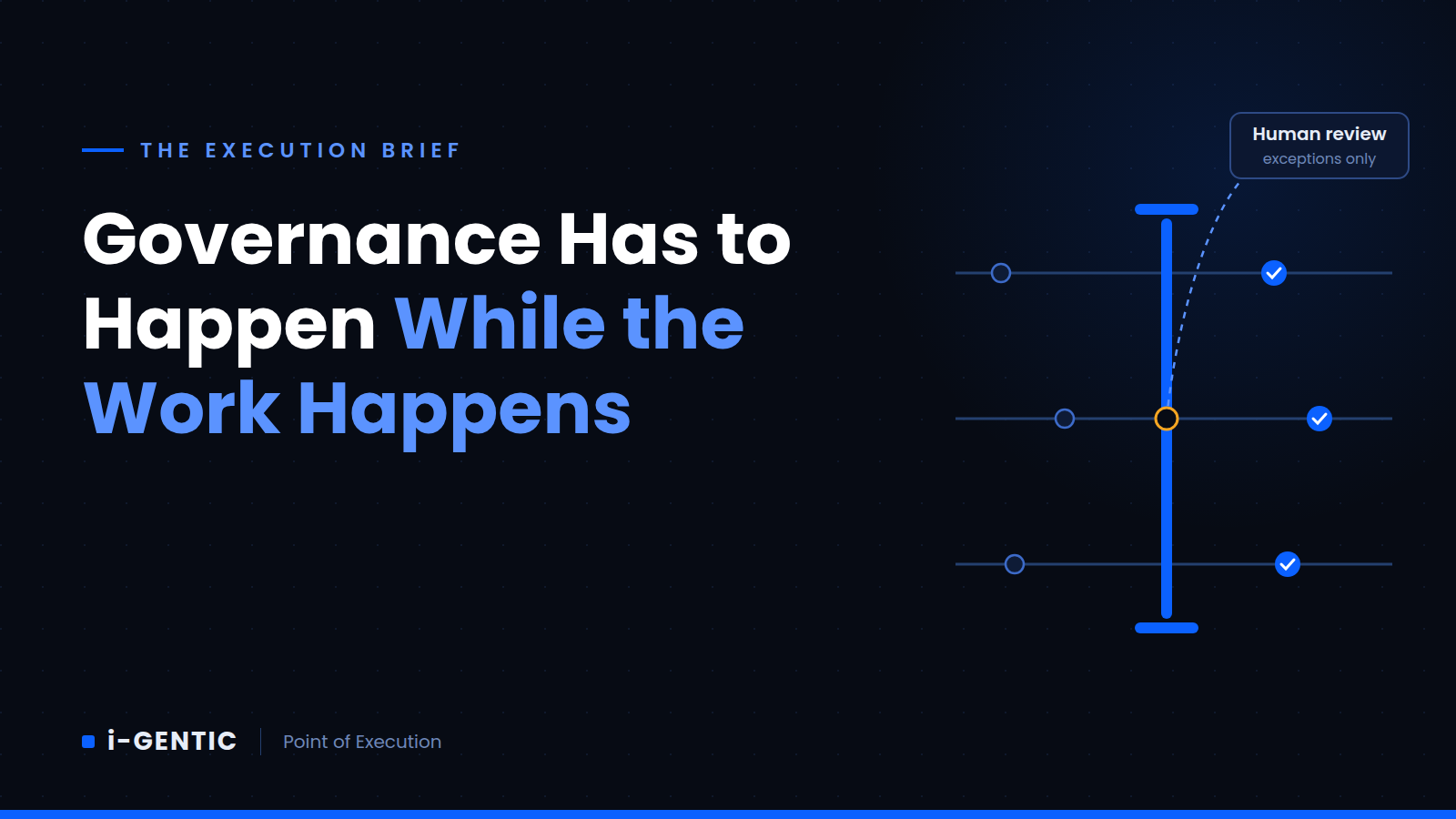
There is a practical alternative, and regulated organizations are beginning to build toward it. Governance can operate during execution. In this model, the rules an organization already maintains, meaning its regulatory obligations, internal policies, and procedures, are expressed in a form that systems can evaluate, and every consequential action is checked against them as it occurs. Compliant actions proceed without friction. Risky actions are flagged or stopped. Ambiguous situations are routed to a person with the context and authority to decide. Every evaluation leaves a record.
This depends on a capability worth naming precisely, because it is often confused with the AI it governs. AI inference is a prediction: the next token, a classification, a score, a recommendation. Compliance inference is a judgment: the evaluation of a specific action against rules, regulations, policies, and situational context to determine whether that action is compliant, risky, or something a human needs to see before it proceeds. An organization can buy a great deal of the first without acquiring any of the second. Governance execution runs on the second.
What changes in the audit conversation
Something useful happens when evaluation moves into the flow of work: evidence becomes a byproduct of operations. Audit preparation in most regulated companies is an archaeology exercise, with teams reconstructing what happened from emails, tickets, spreadsheets, and memory. When each action is evaluated at execution time, the record of what was checked, which rule applied, and who approved the exceptions already exists. Audit readiness becomes a standing condition of how work runs, and the preparation sprint shrinks to a review of records the organization already holds.
The same evidence changes internal conversations. Risk officers can answer questions about AI-driven work with specifics. Legal teams can show what controls applied to a given decision. And the executives sponsoring AI programs can demonstrate to their boards that acceleration and oversight arrived together.
The objection worth taking seriously
The most common concern about execution-time governance is that checking every action will slow the very work AI was adopted to accelerate, or that professional judgment resists being written down as rules. Both concerns deserve respect, and both point toward design requirements. Evaluation has to happen at machine speed to govern machine-speed work, and a buyer should hold any governance platform to that standard. Encoding policy, done well, serves a specific purpose: it lets routine actions proceed and reserves human attention for the situations that need it, delivered to reviewers with full context attached. A compliance officer reviewing two hundred escalated actions with complete records is doing better work than one sampling blindly across twenty thousand.
Where GENIE® fits
i-GENTIC built GENIE® for this operating model. GENIE® ingests external regulations and internal policies, translates them into machine-readable micropolicies, and connects across the existing technology stack so governance happens in real time as actions occur. Organizations use it to manage compliance-sensitive work such as code review, data review, and contract review proactively, with live monitoring, human-in-the-loop escalation where judgment is required, and documented evidence for every review that follows. Customer data stays where it is hosted, and when rules change, updates arrive through micropolicy revisions.
The regulated organizations moving first on this are treating governance as an operating advantage. They can put AI into consequential workflows sooner and with more confidence, because their oversight keeps pace with their execution. That is the position worth building toward, and it is available now.
If you are working through how AI will enter your regulated workflows, we would welcome the conversation. Book a demo to see governance execution applied to a workflow you run today. And subscribe to our newsletter for a monthly briefing on governance in regulated environments.