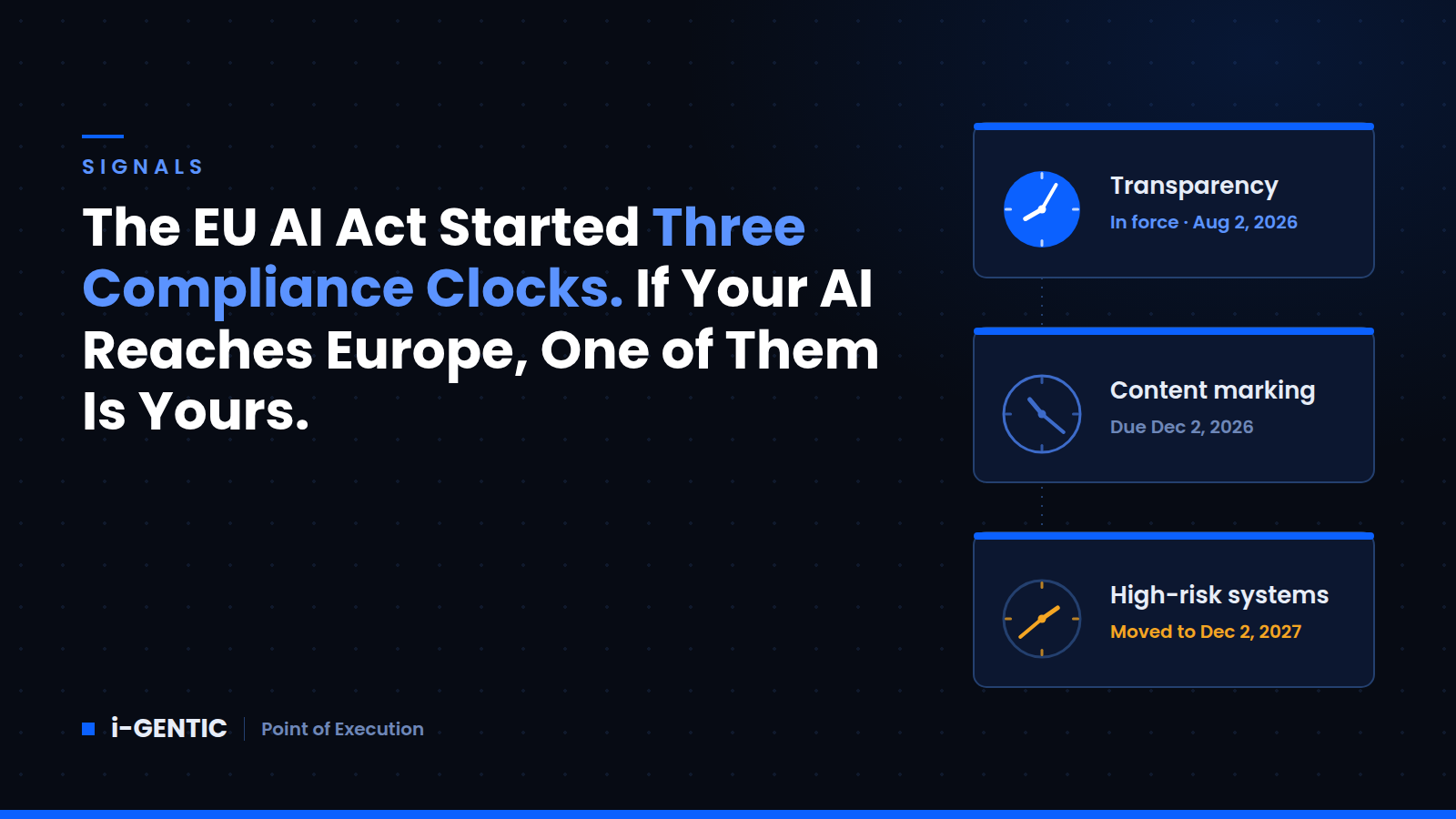
One regulation produced three deadlines moving in different directions, and the obligations that took effect this month follow the same extraterritorial logic as GDPR. For anyone planning AI oversight, the pattern matters more than any single date.
By Jim Edwards, Chief Operating and Marketing Officer | Signals | 4 min read
On August 2, 2026, the EU AI Act moved on three separate timelines at once. The transparency obligations under Article 50 became applicable and enforceable, carrying penalties of up to 15 million euros or 3 percent of worldwide annual turnover. Generative systems already on the market received until December 2, 2026 to meet content marking requirements. And the compliance deadline for high-risk systems in sensitive use categories moved out to December 2, 2027, with high-risk AI embedded in regulated products following in August 2028.
Three clocks, one regulation, one week. Anyone responsible for AI oversight in a regulated organization is now planning against three moving targets at once, and nothing about the next few years suggests that gets simpler.
This reaches further than European operations
A useful clarification for organizations based outside Europe, since the name of the regulation makes it easy to file this as somebody else’s problem. The AI Act reaches providers and deployers established outside the Union where a system is placed on the EU market or where its output is used there. The logic is familiar to anyone who lived through GDPR. A US healthcare organization running an AI assistant that serves European patients, or a financial services firm whose models produce output used in the Union, sits inside the scope of obligations that became enforceable this month.
Deadlines are becoming variables
The high-risk deferral came from sustained industrial and political pressure around European competitiveness, together with a practical problem: the harmonised technical standards that companies would use to demonstrate compliance are still not finished. Michael McNamara, the Irish MEP who served as rapporteur on the AI file under the Digital Omnibus, put the difficulty plainly in an interview this spring.
“The key issue is the absence of harmonised standards. Without them, there is no clear way for companies to demonstrate compliance with the high-risk requirements.”
Michael McNamara, Member of the European Parliament and rapporteur on the AI file under the Digital Omnibus
McNamara has also warned that postponing those standards could be read as deregulation presented under a different name. Set the politics aside and the operating signal is clear enough. Compliance dates for emerging technology are now subject to the same negotiation as any other industrial policy, and the direction of travel can reverse when public pressure shifts.
That creates a specific and expensive problem for the way most organizations run compliance. A program built as a project, scoped to a date, staffed to hit that date, and stood down afterward, generates rework every time the date moves. Teams that spent eighteen months building toward August 2026 now hold a partially completed program with a new target sixteen months out, work that was sequenced for the old deadline, and internal sponsors asking why the urgency changed.
What holds up
The organizations handling this well share a characteristic worth noting. They treat their obligations as a maintained layer rather than a delivered project. Rules are held in a form that can be updated when regulations change, applied consistently to the systems already running, and evidenced on demand. When a deadline moves, the maintenance continues and the target date changes. When a new obligation arrives on a schedule nobody predicted, as Article 50 effectively did for organizations focused on high-risk classification, the capability to apply it already exists.
This is the practical argument for governance that operates during execution rather than governance assembled ahead of an audit. An organization that can apply current policy to current activity, and show what applied and when, absorbs a shifting regulatory calendar as routine maintenance. December 2026, December 2027, and August 2028 all arrive on schedule for that organization, along with whatever follows them.
Ken Washington, who chairs our board after a career leading technology organizations in regulated product companies, has seen this from the inside.
“Every engineering organization I have led planned against regulatory dates, and those dates now move. The practical answer is governance you maintain continuously, so a change in the calendar becomes a routine update instead of a restart.”
Ken Washington, Board Chair, i-GENTIC
GENIE® was built for this condition. It turns external regulations and internal policies into machine-readable micropolicies applied in real time as actions occur, with human review where judgment is required and audit-ready evidence for every governed action. When rules change, the update arrives as a micropolicy revision, which is what allows a compliance program to absorb a moving timeline without restarting.
Jim Edwards is Chief Operating and Marketing Officer at i-GENTIC, where he leads commercialization, go-to-market strategy, and marketing operations for GENIE®, a governance execution platform for regulated environments.
This article is commentary for business and operational planning and does not constitute legal advice. Organizations should confirm their obligations with qualified counsel. The current application timeline is published by the European Commission.
If you are planning AI oversight against a regulatory calendar that keeps moving, book a demo to see governance execution applied to a workflow you run today. And subscribe to our newsletter for a monthly briefing on governance in regulated environments.